
From CAD to Prototype: How to Ensure Design Consistency in Custom Fashion Jewelry
Most jewelry brand founders and designers share the same frustration when outsourcing custom jewelry manufacturing for the first time: the physical prototype looks nothing like the perfect 3D CAD rendering on their screen. The edges are too thick, the intricate details are lost, or the overall weight feels completely off.
At CLF Jewelry, with over 17 years of B2B manufacturing experience, we know that manufacturing jewelry is not just about printing a file. The inconsistency between CAD and reality usually comes down to two hidden engineering factors: Shrinkage Rate during casting and Polishing Loss during surface finishing.
To help our global partners mitigate these supply chain risks, we use a strict 3-Step Prototype Framework to ensure your final pieces match your original vision millimeter by millimeter.
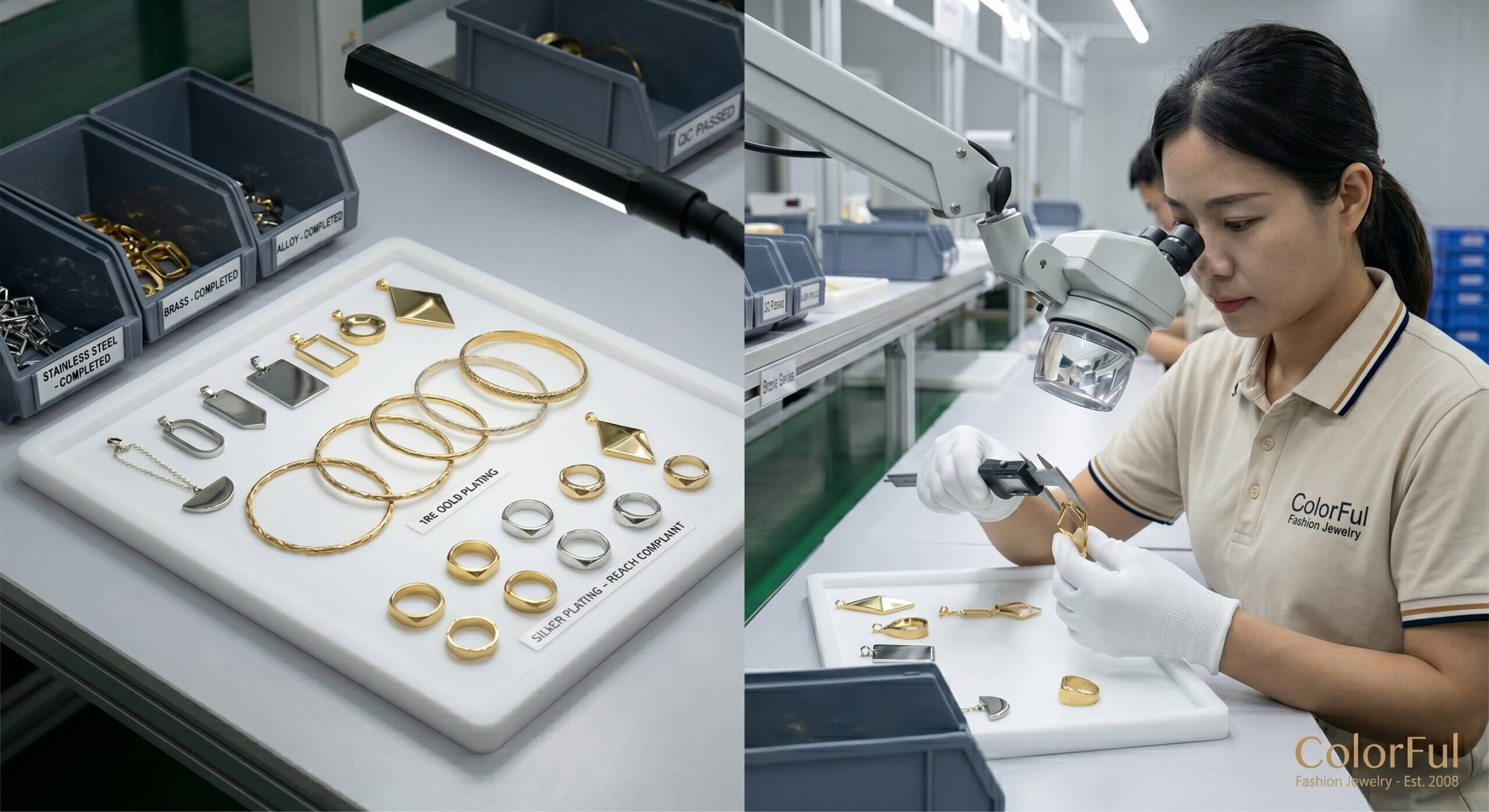
Our 3-Step Prototype Framework
Step 1: Material Constraints First
A perfect product starts with choosing the right base metal for your specific design language. We don’t just accept any CAD file; we match your design with the most stable material:
-
316L Stainless Steel: Best for minimalist, geometric styles requiring high-precision CNC machining and rigid lines.
-
Eco-Friendly Brass: The ideal choice for flexible, detailed casting, especially for designs that require a premium, heavy feel.
-
Zinc Alloy: Perfect for highly complex, 3D sculptural shapes or designs featuring intricate rhinestone/crystal settings. Alloy allows for high-detail mold filling while keeping the unit weight and cost balanced for wholesale markets.
Step 2: Engineering Mold Compensation
To solve the problem of details disappearing during the polishing phase, our engineering team applies a “Mold Compensation” strategy. Before creating the physical mold, we mathematically add a 5% to 8% allowance to the CAD file’s thickness. When the piece undergoes our strict hand-polishing and PVD plating processes, the material wears down to exactly match your original dimensions.
Step 3: Strategic Small-Batch Testing
We never advise our clients to jump straight into mass production with a new design. To minimize your inventory risk, we mandate a strategic small-batch testing phase. By utilizing our low MOQ policy (100-300pcs), you can test the REACH & RoHS compliant plating durability, assemble the components, and validate the market reaction before committing your capital to a bulk order.
Frequently Asked Questions (FAQ) About Custom Jewelry Prototypes
Why does my final jewelry prototype look thicker than my CAD design?
This is a common issue caused by uncalculated polishing loss. Standard factories will use your exact CAD dimensions to make the mold. When the raw casting is heavily polished to achieve a smooth surface, it becomes thinner. To avoid this, factories often over-thicken the mold arbitrarily, resulting in a bulky final product. Precision mold compensation is required to solve this.
How long does it take to get a physical prototype from a CAD file?
The lead time depends entirely on the material and structural complexity. Typically, a standard 316L stainless steel prototype takes 7-10 days. More complex eco-brass or zinc alloy pieces, especially those requiring custom rhinestone settings or multi-layer plating, take about 12-15 days to ensure our strict QC standards are met.
What is the best MOQ to test a new custom jewelry design?
To balance unit cost and market risk, we recommend an initial batch of 100 to 300 pieces per SKU. This volume is large enough to test the consistency of mass production (like plating stability and assembly strength) but small enough to prevent cash flow tie-ups if the design needs adjustments.
Are you ready to turn your 2026 designs into physical prototypes without losing the details? Don’t let manufacturing inconsistencies hold your brand back. Send us your CAD files or sketches today for a technical feasibility review.
Ready to Scale Your Jewelry Brand in 2026? 💎
Don’t let manufacturing inconsistencies hold you back. Get a free 3D CAD rendering and a strategic quote within 24 hours.